

Flicker-Free Interior Lighting for Passenger Coaches
Interior lighting is one of the most effective upgrades you can make to passenger coaches. A softly illuminated train instantly attracts attention during evening operation and helps bring a model railroad to life. Unfortunately, many commercial lighting kits suffer from flickering, excessive brightness and relatively high cost. The good news is that it is possible to build your own flicker-free interior lighting system using inexpensive components and basic soldering skills. The result is reliable illumination that remains lit for several seconds even when power is interrupted.
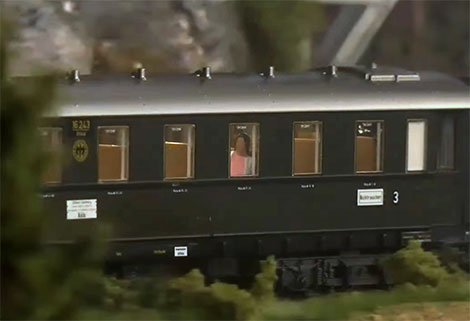
Interior and passengers are only visible if the coach is illuminated
Why Do Passenger Coach Lights Flicker?
Traditional coach lighting relies on direct contact between the wheels and the rails. Even a brief interruption in electrical pickup can cause LEDs to flicker noticeably. Dirt on the rails, turnout frogs, insulated wheelsets, and momentary contact losses all contribute to the problem. Commercial lighting strips often provide little or no energy storage, making them vulnerable to these interruptions. The solution is simple: add a bridge rectifier and a large capacitor. The capacitor stores energy while the coach is running and continues powering the LEDs when track contact is temporarily lost.
Collecting Power from the Track
The first step is installing electrical pickup contacts. For Märklin three-rail systems, power is collected using a pickup shoe connected to the center conductor and a wheel contact spring connected to the wheelsets. For two-rail systems, contact springs are installed on both bogies. The Märklin pickup spring set (#72050) works well for many passenger coaches, although the springs often need trimming to fit correctly. Because these contacts are designed for many different coach types, they are usually longer than necessary. Thin, flexible wire should be used throughout the installation. Flexible PTFE-insulated wire minimizes mechanical resistance and reduces the risk of derailments caused by stiff wiring.
Conductive Couplings
If every coach has its own pickup shoe, operating noise can become excessive. A better solution is to use conductive couplings between coaches. With conductive couplings, power collected from one or two coaches can supply an entire train set. This reduces rolling resistance, lowers noise levels, and simplifies maintenance. Having already one slider under the locomotive I typically always install conductive couplings on locomotives pulling passenger coaches and thereby avoiding sliders under the coaches. When installing conductive couplings, always ensure enough slack remains in the wiring to allow free movement of the bogies in curves.
Hiding the Electronics
Most passenger coaches offer very limited interior space. Fortunately, many coaches contain a toilet compartment that provides an ideal location for the electronic components.
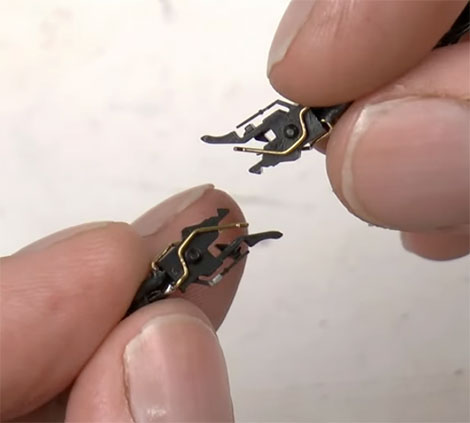
Conductive coupling transfer power between coaches
The heart of the system consists of:
* Bridge rectifier (Surface Mount type)
* 220 µF capacitor rated for 25 volts
* 10 kOhm resistor 1/8 watt axial type
* 100 Ohm resistor 1/8 watt axial type
The bridge rectifier converts track power into a stable DC supply regardless of polarity, while the capacitor stores energy and eliminates flicker. The 10 kOhm resistor reduces the current through the LEDs to a few milliamps. The 100 Ohm resistor limits the maximum charge current to the capasitor. In many coach types the components fit comfortably inside the toilet compartment and remain completely invisible from the outside.
Choosing the LED Strip
LED strips intended for 12-volt operation are inexpensive and readily available. Warm white LEDs generally produce the most realistic appearance for passenger coaches. The strips are supplied with cut marks that allow individual sections to be trimmed to the correct length. A typical roll contains several meters of LEDs, making the cost per coach extremely low—often around one euro or one dollar. Although most LED strips include self-adhesive backing, additional adhesive is recommended to ensure long-term reliability.
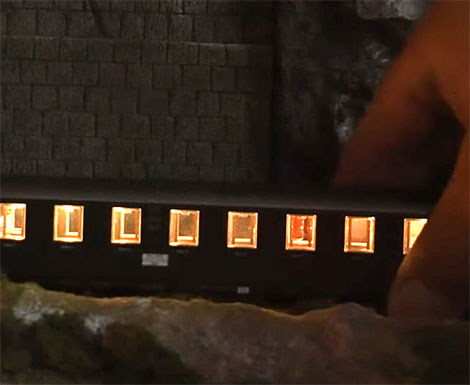
Avoid excessive brightness by use of correct resistors
Adjusting the Brightness
One of the most common mistakes in passenger coach lighting is excessive brightness. Real passenger coaches do not resemble brightly lit office buildings. A softer, warmer glow usually looks far more convincing. Brightness can be reduced by installing two 10 kΩ resistors in series with the LED strip. If brighter lighting is desired, use lower resistor values. For a dimmer appearance, increase the resistance. Experimentation is worthwhile because lighting levels often appear different when viewed on the layout compared to a workbench.
Adding Passengers
Once the lighting is installed, empty interiors become immediately noticeable.Adding passengers dramatically improves realism and helps justify the illuminated interior. A few seated figures distributed throughout the coach are usually sufficient to create the impression of a busy train. Passenger figures are often one of the least expensive upgrades that produce the greatest visual impact.
Rear Marker Lights
The final coach in a train can be enhanced further with red marker lights. Small pre-wired red LEDs can be installed directly into existing lamp housings or openings in the coach body. These LEDs require very little space and add a highly realistic finishing touch to the train. When combined with interior lighting, the result is particularly impressive during nighttime operation.
Performance in Operation
One major advantage of this design is the large energy-storage capacitor. When power is removed, the lighting remains illuminated for approximately 10 to 12 seconds before fading out.
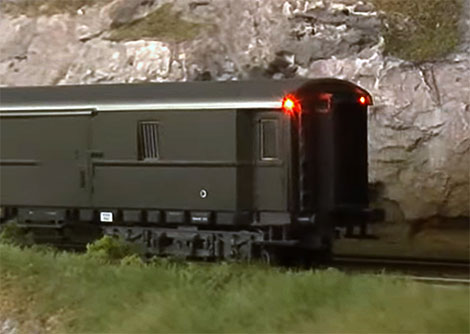
Red rear marker lights
This completely eliminates visible flicker caused by dirty track, turnouts, or brief contact interruptions. The result is a smooth, realistic lighting effect that significantly improves the appearance of passenger trains.
Conclusion
Flicker-free interior lighting is one of the most worthwhile upgrades for passenger coaches. The materials are inexpensive, installation is straightforward, and the improvement in realism is immediate. By combining reliable electrical pickup, a bridge rectifier, a large capacitor, and warm white LED strips, it is possible to create professional-quality coach lighting for a fraction of the cost of many commercial systems. The result is passenger trains that look realistic both day and night, while operating reliably even over complex trackwork and less-than-perfect rail conditions.