Digital control
Digital DCC control has completely changed the way model railroads are operated compared to traditional analogue systems. With an analogue controller, the voltage in the rails controls the speed and direction of the train. This means that all locomotives within the same electrical section move together. In order to operate several trains independently, the layout must therefore be divided into many isolated track sections with switches and complicated wiring.
The Digital Revolution
A digital DCC controller works in a completely different way. Instead of controlling the voltage, digital commands are sent through the rails to each locomotive individually. Each locomotive has its own decoder and digital address, allowing several trains to operate independently on the same track at the same time.
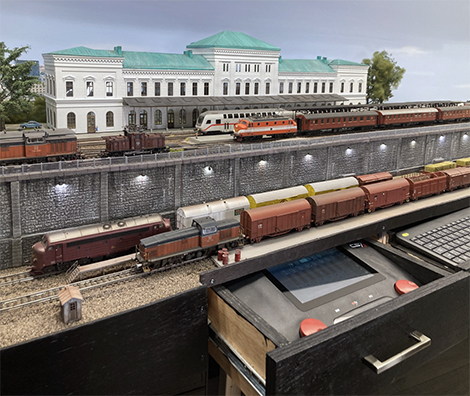
Increased Realism with Sound Effects and Braking Characteristics
DCC also makes it possible to control many additional functions directly from the controller. Modern locomotives can feature realistic sound, smoke generators, lighting effects and programmable acceleration or braking characteristics. Turnouts, signals and accessories can also be digitally controlled and automated.
Mobile Train Controls
Modern digital systems can furthermore be connected to computers, tablets or smartphones, making advanced traffic control and fully automated operation possible even on relatively small model railroads.